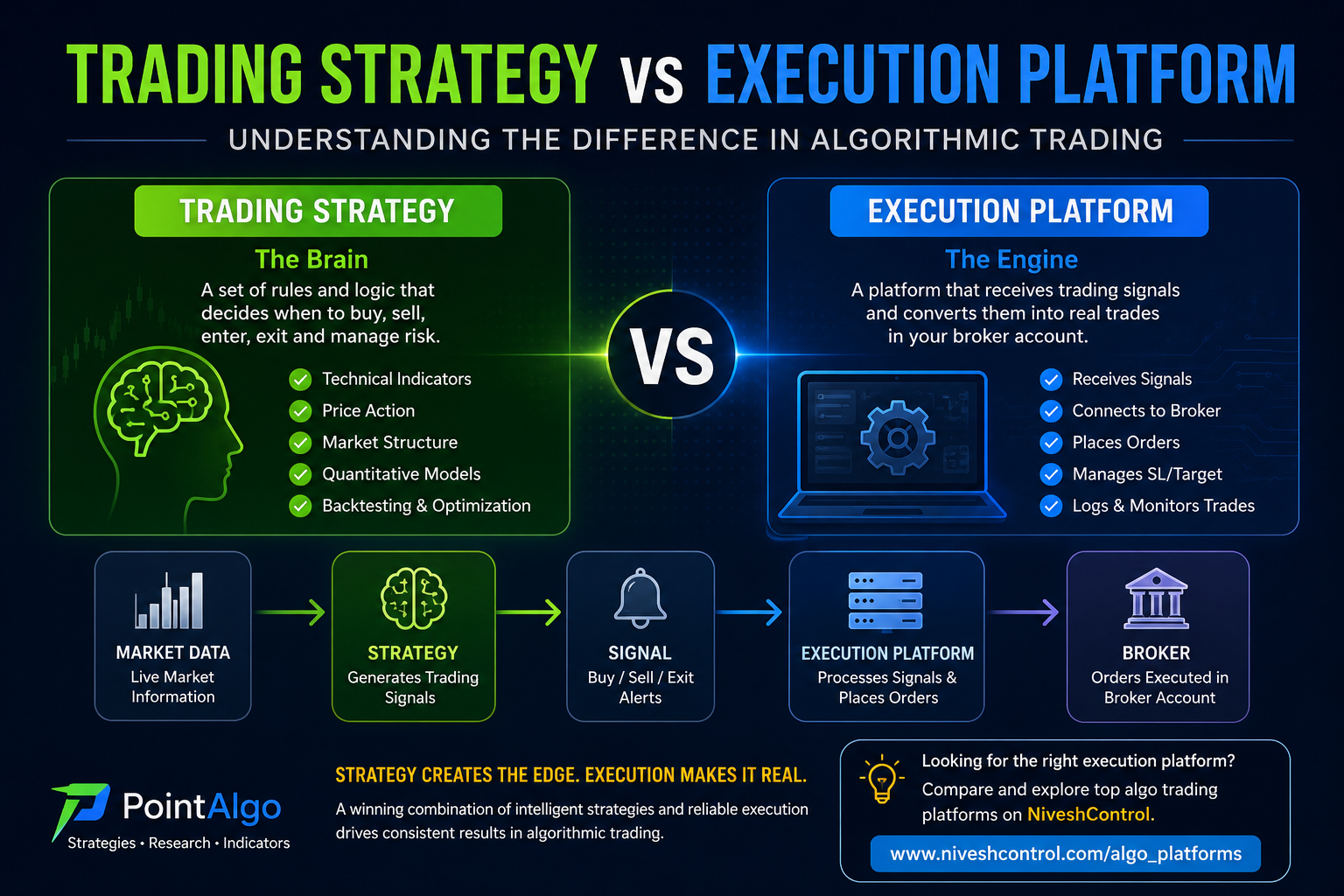
Many traders entering the world of algorithmic trading assume that a trading strategy and an execution platform are the same thing. In reality, they serve completely different purposes.
A profitable algorithmic trading setup consists of two essential components: a well-tested trading strategy and a reliable execution platform that automatically places trades. Understanding this distinction helps traders build more reliable and scalable trading systems.
What is a Trading Strategy?
A trading strategy is a predefined set of rules that decides when to buy, when to sell, where to exit, and how much risk to take.
These rules may be based on:
- Technical indicators
- Price action
- Market structure
- Volume analysis
- Quantitative models
- Statistical research
- Machine learning models
The strategy generates trading signals. It does not place orders in your broker account. This is where many beginners become confused.
What is an Execution Platform?
An execution platform receives trading signals and converts them into actual buy or sell orders. It acts as the bridge between your trading strategy and your broker.
Typical responsibilities include:
- Receiving TradingView alerts
- Connecting with broker APIs
- Placing market or limit orders
- Managing stop-loss and target orders
- Handling order retries
- Managing multiple accounts
- Logging executed trades
Without an execution platform, most strategies remain manual.
Where Does PointAlgo Fit?
PointAlgo focuses on the research and development side of algorithmic trading. We build:
- Quantitative trading strategies
- Professional TradingView indicators
- Pine Script strategies
- Custom trading systems
- Market research models
- Signal generation logic
- Strategy optimization
Our goal is to help traders develop rule-based systems backed by research instead of emotions. PointAlgo does not operate as a broker or trade execution platform.
How Strategy and Execution Work Together
A typical workflow looks like this:
Each component has a specific responsibility. Keeping strategy development separate from execution makes the system more flexible and easier to maintain.
Choosing the Right Execution Platform
Once your strategy is ready, the next step is selecting an execution platform that matches your requirements.
Some important factors include:
- Supported brokers
- TradingView integration
- Webhook support
- API connectivity
- Multi-account trading
- Risk management features
- Order reliability
- Pricing
- Paper trading
- Backtesting compatibility
Instead of reviewing each provider individually, you can compare multiple execution platforms in one place on NiveshControl's Algo Platforms directory:
NiveshControl Algo Platforms Directory
Evaluate execution platforms based on supported brokers, automation features, integrations, pricing, and other capabilities before choosing the one that best fits your workflow.
Browse Algo PlatformsWhy Keeping Strategy and Execution Separate is a Good Practice
Professional quantitative traders rarely tie their strategy to a single execution platform. This approach provides several benefits:
- Easier platform migration — Switch execution providers without rewriting your strategy
- Better scalability — Run one strategy across multiple accounts or brokers
- Improved testing — Test strategies independently of execution infrastructure
- Lower operational risk — Isolating failure points protects your capital
- Greater flexibility — Use the best tool for each job
- Freedom to choose different brokers — Optimize commissions and latency
The strategy remains independent while the execution layer can be changed whenever needed.
PointAlgo's Approach
At PointAlgo, we specialize in developing intelligent trading systems powered by quantitative research. Our focus includes:
- Custom TradingView indicators
- Pine Script development
- Strategy research
- Signal generation
- Quantitative models
- Algorithmic trading logic
- Strategy optimization
Once a strategy is finalized, traders can integrate it with a compatible execution platform of their choice to automate order placement.
Final Thoughts
Successful algorithmic trading is built on two pillars: a robust strategy and dependable execution.
A profitable strategy identifies opportunities, while an execution platform ensures those opportunities are translated into real trades accurately and efficiently.
If you are looking for professionally developed trading strategies, indicators, and quantitative research, PointAlgo focuses on building the intelligence behind your trading decisions. When it is time to automate those signals, you can compare compatible execution platforms through NiveshControl's Algo Platforms directory to find the solution that best fits your trading setup.
Ready to Build Your Trading Strategy?
Explore our quantitative strategies, Pine Script indicators, and market research tools.
Explore Strategies